June 15, 2026
•
Insights
.avif)
What do general counsels in financial services say when the doors are closed? Some conversations only happen when the right people are in the right room.
Adopting AI for legal services can feel like a complicated process. In the financial services sphere, where lawyers are already navigating a tightly regulated, inflexible and highly complex world, it’s even harder.
Definely is built by lawyers. Speaking to decision makers, innovators, lawyers on the ground, and continuing to have no holds barred conversations has always been a vital part of Definely’s process.
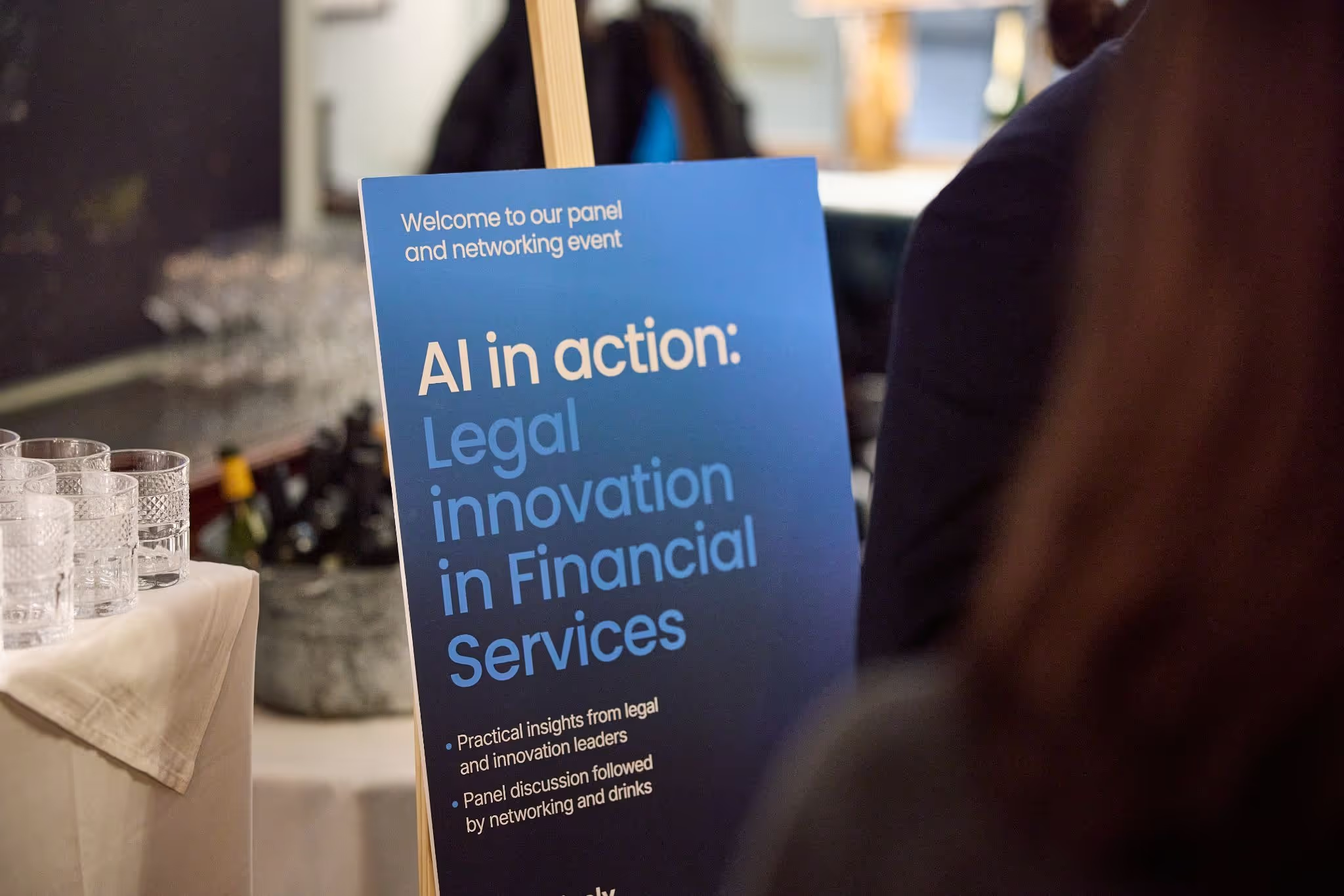
Last month, we brought together a group of senior legal leaders from across financial services for an evening that was designed to cut through the noise. No pitch decks, no recycled conference talking points. Just candid, closed-door conversation about what's actually happening on the ground when legal teams in financial services try to adopt AI.
What followed was one of the most honest conversations we've heard in this space.
We were delighted to host two experts on the topic: Christian Bettley, former deputy counsel at a Global Financial Institution, and qualified lawyer with over 25 years' experience in financial markets, and Helga Butcher, an advisory consultant at Cognia Law with extensive experience in legal operations, alongside Rhys Hodkinson, former lawyer at Baker McKenzie and CRO of Definely.

For general counsels in financial services, the current expectation from the C-suite is “just do something with AI”. What, exactly, is pretty vague. And yet the pressure is building.
As we learned during the course of the evening, teams currently face three key barriers.
Financial institutions are highly regulated and highly complex, so employing AI can feel incredibly risky. Expectations from C-suite and the reality of implementation are wildly different. It’s the General Counsel’s job to manage that gap and do the research to find what will add value and what won’t.
Making a case for value is a conundrum of its own. The first question most businesses will ask is: how much does it cost and what is the ROI? Cost is easy to answer, but quantifying return on investment is trickier to define - legal has only ever traditionally been measured on cost, not value-add. Rhys Hodkinson, CRO at Definely says: “ROI and legal is so hard to quantify, because you're often asked to measure it in isolation to how legal impacts the rest of the business. What we see with really good ROI calculations and business cases is the ability to free up that time”. Reducing bottlenecks in the business is also a key consideration.

For Christian Bettley, it’s important for financial institutions to rip the band aid off. The aim is to get your lawyers and teams used to employing AI, and moving them along the curve of progress: “AI currently is good at working on simple things - similar to a trainee lawyer. In a few years time a trainee lawyer will be working on more complex things. AI is the exact same. So it’s best to begin now”.
Every decision maker in a law firm will have been bombarded with emails asking them to try this or that AI tool, that it will revolutionise the job. So, how to sift through the rubbish and find the gold?
For Helga Butcher, it’s a case of focusing on your “burning platform” - the area of the business most in need of help. This will inform what sort of tool you’re looking for. Once you’ve found that, you can work backwards.
Next step: tap into your network. There will be people and firms in your circle who have already experimented with different tools. Capitalize on their experience and opinions to inform your path forward.

Once you’ve decided on the problem you need to solve, Butcher says, you’re going to have to design your KPIs and defend them effectively. Figure out what you want to measure, how you're going to quantify it, and a solid rationale for why these are the right numbers to focus on. This is how you’re going to sell it to the C-suite, and also how you're going to quantify success.
How do you tell the difference between a good demo and a work of complete fantasy? It’s a topic that Hodkinson is well versed in: “Demos are always done on clean, structured data sets that look pretty. The practicalities of adopting and implementing AI in complex enterprises is an entirely different world”.
If a vendor is showing you a demo on a slide deck or a video, it’s a red flag. The real test will be to show you how the tech works on one of your own contracts - that makes it easier to picture how it will work in your business.
For Bettley, the real valuable test is getting the tech in and playing with it - you’ll be able to investigate integration problems, and build a list of useful questions you can quiz the vendor on. Good vendors will be honest and open about what the tool can do for financial services.
Setting aside an afternoon for the team to take part in a promptathon is another good idea to test how the team will use the tool. Crowdsource questions and issues, get a feel for how intuitive the tool is, whether they like it - it also gives you a head start on the next problem. Adoption.
Choosing the tech is one challenge. Making sure people use it is quite another. Some firms are choosing to tie adoption to performance management. It’s one option, but if a tool is worth its salt, you shouldn't have to incentivise people to use it.

The tool you choose needs to actually make someone’s job easier, smoother or better. If it’s not doing that, why would anyone use it? The tool also needs to be intuitive. Lawyers are time poor and have a lot to think about. If they are expected to spend weeks learning a new piece of software, the chances are they simply won't bother.
You need to create the right atmosphere to drive adoption - an environment where people want to use technology and are incentivised to drive it. As Bettley puts it, it needs to be “the right lawyer with the right mindset”.
For Hodkinson, it’s sometimes reliant on the business structure: “Implementing AI, allowing it to become part of the business, is starting to reflect on how good internal data structures are. How clean is labelling and curation? The output and results achieved is often a reflection of other work that takes place behind the scenes”. Extra resources could be required to clean up and create templates and playbooks. It’s not an insignificant hurdle.
So how do you guarantee it? Butcher believes it’s up to leaders to take action and follow through, “You can’t just drop a technology and run. Any change in a business requires followthrough. True adoption requires energy, process and proper support”. Don’t expect the technology to be adopted overnight. It will take a sophisticated programme around education, training and on-the-day support. “You have to build it into your plan”.
The other ingredient is picking a vendor that is incentivised to work with you. Be up front about how much support you expect or need, and find out what the vendor typically provides to support adoption. The level of support they are willing to give can be a strong indicator of how serious they are about your team using the tool in the long term.
The important thing is to take action now, Bettley says. The market has changed and AI is coming for all professional services, so get out of the gates and get going now. “There’s no point in waiting around, there’s never going to be a good time to get started, so pick something now”. While this might sound rash, for Bettley it’s about getting the team accustomed to using AI, getting the infrastructure together and moving the company along that curve of adoption. That’s the key to moving forward.

The conversations that matter most rarely make it onto a conference agenda.
What was said in the room, the frank admissions about what hasn't worked, the practical advice shared between peers who've actually been through it - is the kind of insight that's hard to find anywhere else. You won't see it in a whitepaper and you won't hear it on a webinar.
It’s exactly why we keep bringing these rooms together.
If you would like to join a future Definely event, register your interest below.